Plan
What are we doing today, and what is the purpose of the session?
 Book an inquiry ↗
FREE COACH + PARENT RESOURCE
A simple process for helping coaches, parents and organizations prepare for predictable problems, communicate clearly and make better decisions when conditions change.
HOW TO USE THIS RESOURCE
At Summit 2911, our goal is not to remove every risk from sport. That is impossible. Our goal is to help coaches, parents and organizations recognize unnecessary risk, prepare for predictable problems, communicate clearly and make better decisions when conditions change.
That is what we mean by Build the Athlete. Protect the Journey.
THE COMPLETE VISUAL GUIDE
Review it with the staff before practice, use the worksheet to identify and control risk, and assign emergency responsibilities before athletes begin.
Download the guide ↓PNG · FREE TO DOWNLOAD AND SHARE FOR EDUCATIONAL USE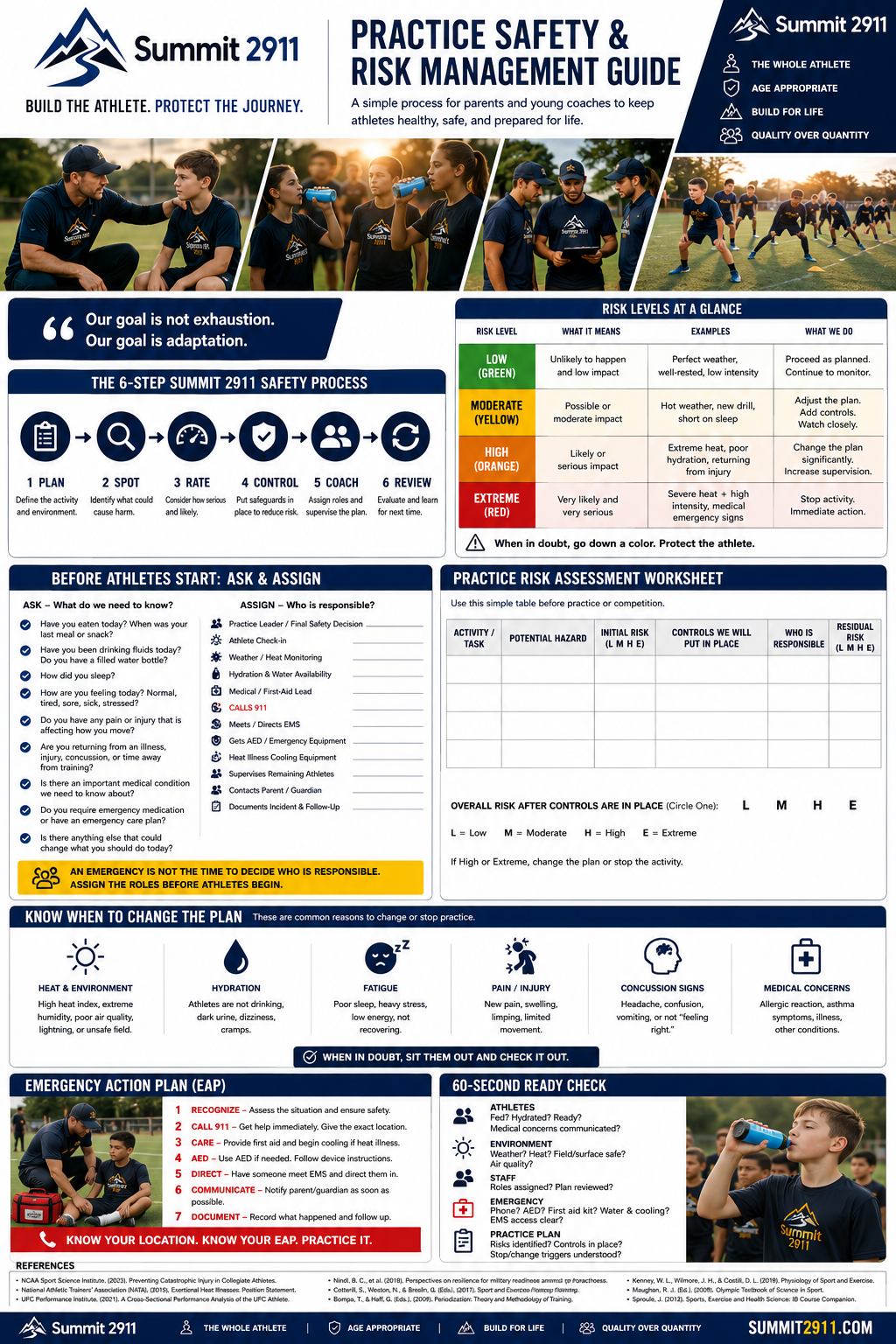
THE SIX-STEP PROCESS
This is a conversation tool—not just a form. You do not need a sports-science degree to use it.
What are we doing today, and what is the purpose of the session?
What could go wrong—heat, weather, fatigue, equipment, hydration, injury, limited supervision or a new drill?
How likely is the risk, and how serious could the outcome be?
Change the drill, reduce volume, add recovery, move practice, increase hydration, add supervision or hold an athlete out.
Assign responsibility, communicate the plan and supervise the activity.
After practice, discuss what worked and what should change tomorrow.
Many of the principles behind this guide come from years of experience working in high-risk tactical and human-performance environments, where physical stress, environmental conditions, fatigue, equipment, communication and human decision-making can all influence the outcome.
In those environments, risk management is not simply paperwork completed before an event. It is an ongoing decision-making process.
That same mindset has tremendous value in sport. A practice field is obviously different from a tactical environment, but the principle transfers well:
Good preparation creates better decisions when something unexpected happens.
High-risk operational guidance similarly emphasizes understanding human limitations, equipment limitations, environmental conditions, individual readiness and knowing when risk has reached a point where an activity should not continue.
One of the most important Summit 2911 principles is that readiness matters.
Athletes do not arrive at practice as blank slates. They bring school stress, sleep, nutrition, hydration, previous training, soreness, illness, injuries, emotional stress, travel, growth and development with them.
Athlete-monitoring science supports looking at multiple pieces of information and recognizing that athletes can respond differently to the same training stress. The broader performance literature also supports an integrated approach rather than relying on one test, wearable, score or measurement to determine readiness.
This is not about diagnosing athletes. It is about gathering enough information to make a better coaching decision.
One lesson that carries directly from high-risk operational environments is this: when something goes wrong, people should already know their job.
Before athletes start, assign responsibilities:
These may seem like small details when everything is going well. They become very important when it is not. An emergency is not the time to decide who is responsible.
One of the biggest mistakes coaches can make is believing that changing the practice means the original plan failed. Sometimes changing the plan is exactly what good coaching looks like.
If athletes arrive exhausted, the temperature climbs, hydration becomes an issue, movement quality deteriorates, an athlete reports pain, equipment fails or something simply does not look right—reassess.
The athlete and environment look as expected.
Ask more questions. Reduce volume, intensity, complexity or contact. Increase recovery and watch closely.
Concerning medical symptoms or emergency signs require appropriate medical or emergency action.
Exercise physiology tells us that environmental conditions can significantly alter physiological strain during exercise, making environmental planning part of performance planning rather than an afterthought.
This guide is not only for coaches. Parents often have information that coaches do not.
Your athlete may have slept poorly, barely eaten, been sick, started a medication, complained of headaches, struggled with hydration, had a stressful week or participated in several other practices or games. Communicate important information.
Parents do not need to coach from the sideline, but they should help create an accurate picture of the athlete. Likewise, coaches should create an environment where athletes feel comfortable saying, “I do not feel right today.”
That statement should start a conversation—not result in punishment.
We are trying to build a better culture around youth performance.
Not softer athletes. Not fearful coaches. And not risk-free sport.
We want prepared coaches, informed parents, confident athletes, coordinated staffs and organizations capable of making good decisions under pressure.
The best performance systems integrate information across coaching, performance, recovery, health, nutrition and the athlete rather than allowing each area to operate independently. At Summit 2911, we apply that thinking to the developing athlete.
Because the objective is not to survive today’s workout. The objective is to help young athletes continue growing.
The goal is to develop the movement, strength, speed, confidence, resilience, habits and character that allow an athlete to build for life. One practice matters. But the journey matters more.
Prepare before the session. Communicate before there is a problem. Assign responsibility before there is an emergency. Monitor the athlete and the environment. Change the plan when the situation changes. Learn from every session.
Purpose. Hope. Future.This resource is educational and does not replace medical care, athletic training support, emergency action plans or guidance from qualified professionals. If an athlete shows emergency signs or rapidly worsening symptoms, stop activity and activate the local emergency response plan.
Download the visual guide ↓